


Exploring Alternative Asset Allocations For DIY Investors
Episode 359: Portfolio Analyzers, The Logo, The Website, Best In Class ETFs And Portfolio Reviews As Of August 9, 2024
Sunday, August 11, 2024 | 37 minutes
Show Notes
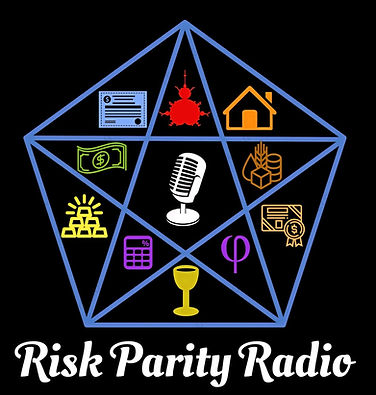
In this episode we answer emails from Frank, Michael and Aaron. We discuss four good portfolio analyzer tools, the hidden meanings in the Risk Parity Radio logo, the deficiencies of the website and where to find good international funds to use for portfolio construction.
And THEN we our go through our weekly portfolio reviews of the eight sample portfolios you can find at Portfolios | Risk Parity Radio.
Additional links:
Father McKenna Center Donation Page -- Remember to mention "The Financial Quarterback match" in new donations: Donate - Father McKenna Center
Portfolio Visualizer Monte Carlo Simulator: Monte Carlo Simulation (portfoliovisualizer.com)
Portfolio Charts Portfolio Matrix Tool: Portfolio Matrix – Portfolio Charts
Early Retirement Now Toolbox: An Updated Google Sheet DIY Withdrawal Rate Toolbox (SWR Series Part 28) - Early Retirement Now
Testfolio Calculator: testfol.io
Geometric Golden Ratio Pentagon: Golden Ratio in Regular Pentagon (cut-the-knot.org)
Misbehavior of Markets Book: The (Mis)Behavior of Markets by Benoît B. Mandelbrot | Goodreads
More Than You Know Book: More Than You Know: Finding Financial Wisdom in Unconventional Places by Michael J. Mauboussin | Goodreads
Merriman Best In Class ETF List: Best-in-Class ETF Recommendations | Merriman Financial Education Foundation (paulmerriman.com)
Video Re Best In Class ETFs: Bootcamp #9 Best in Class ETF Update 2024 (youtube.com)
DFA Mutual Fund List: Funds | Dimensional
Truncated AI-bot Summary:
Can you imagine transforming your financial journey in the same way you might find camaraderie in your favorite dive bar? Welcome to Risk Parity Radio! Listener Frank reaches out with gratitude and a request for the best tools to backtest portfolios and determine safe withdrawal rates. We also tip our hats to Frank's generous donation to the Father McKenna Center, underscoring our ongoing charity drive in collaboration with the Financial Quarterback podcast.
Ever wondered which platforms provide the most reliable data for crafting your financial future? We break down some of the top tools in the industry, like Portfolio Visualizer, Portfolio Charts, and the Early Retirement Now toolbox, along with the new player, Testfolio. Along the way, we debunk myths around CAPE ratios and share a heartfelt story about our Risk Parity Radio logo, born out of the creativity sparked during the 2020 lockdown.
From a cheerful Scottish greeting to a deep dive into international investing, this episode promises both humor and expertise. We tackle Aaron’s email about international ETFs, emphasizing the importance of non-overlapping funds for true diversification. Drawing from resources like the Merriman Foundation and Chris Pedersen's analyses, we guide you in selecting top-tier funds from DFA and Avantis.
Bonus Content
Transcript
Not Uncle Frank [0:01]
A foolish consistency, is the hobgoblin of little minds, adored by little statesmen and philosophers and divines.
Uncle Frank [0:10]
If a man does not keep pace with his companions, perhaps it is because he hears a different drummer.
Not Uncle Frank [0:17]
A different drummer and now, coming to you from dead center on your dial, welcome to Risk Parity Radio, where we explore alternatives and asset allocations for the do-it-yourself investor, Broadcasting to you now from the comfort of his easy chair. Here is your host, Frank Vasquez.
Uncle Frank [0:37]
Thank you, mary, and welcome to Risk Parity Radio. If you have just stumbled in here, you will find that this podcast is kind of like a dive bar of personal finance and do-it-yourself investing. Expect the unexpected. It's a relatively small place. It's just me and Mary in here and we only have a few mismatched bar stools and some easy chairs. We have no sponsors, we have no guests and we have no expansion plans. I don't think I'd like another job. What we do have is a little free library of updated and unconflicted information for do-it-yourself investors. Now, who's up for a trip to the library tomorrow? So please enjoy our mostly cold beer served in cans and our coffee served in old chipped and cracked mugs, along with what our little free library has to offer. Welcome. Of the eight sample portfolios you can find at wwwriskparryradarcom on the portfolios page.
Not Uncle Frank [2:08]
Boring.
Uncle Frank [2:10]
And yes, it did end up being kind of a boring week after all of the drama earlier in the week. You can't handle the dogs and cats living together. But before we get to that, I'm intrigued by this how you say Emails and First off. First off, we have an email from Frank.
Not Uncle Frank [2:34]
Any of you guys call me Francis and I'll kill you.
Not Uncle Frank [2:39]
And Frank writes Thank you for all the time you have dedicated to this excellent podcast. I've learned a great deal and it has been helpful in constructing my decumulation portfolio. Which website do you recommend for backtesting and checking safe withdrawal rates? Also, could you please send me an explanation of your logo? Fyi, I made a donation to the Father McKenna Center and included the financial quarterback match. Once again, thank you and keep up the great work. Frank and I don't like nobody touching my stuff, so just keep your meat hooks off. If I catch any of you guys in my stuff, I'll kill you.
Uncle Frank [3:20]
Well, first off, thank you for your donation to the Father McKenna Center, which is why you go to the front of the line. Yes, as most of you know, we do not have any sponsors for this podcast, but we do have a charity we support. It is called the Father McKenna Center and it supports hungry and homeless people in Washington DC. Full disclosure. I am on the board of the charity and am the current treasurer.
Not Uncle Frank [3:47]
That's the fact, Jack.
Uncle Frank [3:49]
That's the fact, jack, we are running a two-for-one promotion these days. Double your pleasure, double your fun. I appeared on a podcast called the Financial Quarterback a couple of weeks ago and they offered to match donations to the Father McKenna Center for up to $10,000. And so I'm asking those of you who are so inclined to make your donation and the way you should do that is go to the Father McKenna website donation page, which I'll link to in the show notes Make your donation by credit card or by check or by donor advised fund or donation of shares. We take all kinds and when you do that, put the financial quarterback match in the little comment box they have there so we can count it for the promotion and go get those matches.
Uncle Frank [4:44]
And I do want to thank all of you who have given so far. We've gotten a lot of donations in over the past couple of weeks here and we will be getting towards that goal pretty soon here. I think we just need a little bit more to put us over the hump, and so we'll be doing this at least for the next five days or so, I think, which would make it a month-long promotion, but hopefully after that we will have obtained all the matching dollars that are available. So if you want to be the one who puts us over the hump, this would be a great time to go to that donation page.
Not Uncle Frank [5:23]
What we do is, if we need that extra push over the cliff, you know what we do Put it up to 11. 11, exactly.
Uncle Frank [5:30]
And thank you again for your support. Now getting to your questions. First, which website do you recommend for backtesting and checking safe withdrawal rates? Well, I would use more than one website for that. I think it's best to use multiple websites because they each have different sets of data, longer or shorter, and some of them narrower and some of them broader, depending on what you are testing, because really, at the end of the day, what you care about the most is the relative comparison of one portfolio to another, and you want to run that on as many different data sets or sites as you have available. So the ones we typically use around here are Portfolio Visualizer and Portfolio Charts. Portfolio Visualizer has a very broad data set. It's not necessarily that deep and unfortunately they've taken away a lot of the functionality to it for specific ticker symbols, but you can still get the full functionality as to asset classes, which is actually more important, and run Monte Carlo simulations in there as well as back tests, which will spit out a plethora of data and allow you to compare more than one portfolio against another one.
Uncle Frank [6:53]
Portfolio Charts is near and dear to my heart. It was started by an engineer named Tyler who has been running it for almost 10 years now and is where the Golden Butterfly portfolio originated. It has data back to 1970, and it is also testing asset classes and sub-asset classes. But it has a variety of calculators, not only a safe withdrawal rate calculator but something I'll link to in the show notes which is called the portfolio matrix. Now what the portfolio matrix is it's an easy way to compare your portfolio against a whole bunch of common portfolios, like a regular 60-40 or a Boglehead 3 fund or a Rick Ferry Core 4. And there are about 20 different standardized portfolios in there and so you can put your own portfolio in there to compare it against those on a bunch of different metrics, including things like total returns, safe withdrawal rates, perpetual withdrawal rates, steepest drawdowns, etc. Kind of all in one place. And that's kind of a very nice place to take your latest bright idea and just throw it in there, because you have that instantaneous comparison ability with these other portfolios.
Uncle Frank [8:16]
Now another very useful calculator is the toolbox that you can download from Early Retirement Now, which is Karsten Jesko or Big Earn's website, and that is a useful tool because it has data that goes all the way back to the 1920s for factor investing and then even further back for some of the more narrow assets and you can also put treasury bonds of various durations in there and gold. It is a little bit more difficult to use because it is actually a spreadsheet that you're working with and you need to make sure that you're putting the numbers that you want in the right boxes, but it's very useful to get that hundredyear perspective. I'm not sure how useful the data is prior to the 1920s. The only part of that tool that I don't think is useful at all has to do with trying to use CAPE ratios to predict things or modify things, because they just don't work very well and they are very unstable. I was listening to an interview of Jeremy Grantham last week, who is one of these people who likes to try to use these ratios to predict or modify a portfolio, and he said a couple of interesting things. He said in the 20th century the average CAPE ratio for the S&P was about 14. In the 21st century it is 21. And so you can see that as markets change and the composition of a market changes in this case, adding more technology and having less capital-intensive industries like oil wells and steel mills that you really cannot use CAPE ratios to predict anything, and Michael Kitsis have written a couple articles about this in 2014 and 2016,.
Uncle Frank [10:09]
Poo-pooing the whole exercise. But the rest of that toolbox is most excellent and I would definitely try to run your portfolios back in time like that to the extent you can, because the asset classes there are limited and the way you need to put in the modifications for Fama French factors is also kind of an academic exercise. Basically, it allows you to change the makeup or factor mix of a portfolio, but does not allow you to say specifically, okay, I want 40% in small cap value. But if you can overcome those technicalities, you will find it quite useful, and I have been able to run portfolios like the Golden Butterfly and Golden Ratio back to the 1920s to show that, yes, it is possible to get portfolios that have 5% safe withdrawal rates. But I've talked about that before, so I will not be talking about it again right now. Forget about it.
Uncle Frank [11:13]
Now there is a new kid on the block the Testfolio tool that someone has created and put out for free. That allows you to do a lot of the things with tickers that you used to be able to do at Portfolio Visualizer until they took that capability away and started trying to charge people for it. So Testfolio is also a very interesting back tester because it allows you to model managed futures back to the 1990s and is really the only one of these tools that allows that, at least for that length of time. And you can put in up to five portfolios in there and run them against each other to see how they would have performed. And he's also created a number of indexes of standardized data that go back many decades in some cases and a few decades in other cases. So that is a fourth tool that is now available and you should be using. It does not have a specific safe withdrawal rate calculator, but you can put in a feature whether you're putting money into the portfolio or taking money out of the portfolio and use it to compare portfolios that way to see which one is better.
Uncle Frank [12:26]
But now we get to your fun question, which is an explanation of the Risk Parity Radio logo. Surely, you can't be serious. I am serious and don't call me Shirley. This podcast was originally a COVID project that was started in 2020. Covid project that was started in 2020. And since I had a lot of time back then to fiddle around with things like logos and websites and other stuff like that. I sat down and created this little logo for just for fun at first. I did go and get a trademark on it, also just for fun. To go through that process. I have an odd sense of fun. It was interesting getting the trademark for it.
Uncle Frank [13:07]
But let's talk about all the hidden meanings inside of it, because I think it was kind of fun to construct this. First of all, the reason that it is a star inside a pentagon, also known as a pentagram I'd sell my soul for a donut. Well, that can be arranged. Thunders, you're the devil, it's always the one you least suspect Is because that is a geometric representation of the golden ratio. And the ratio between one of the lengths of the star and one of the Pentagon sides is in fact the golden ratio. And if you take a whole bunch of other segments out of that and I'll put a geometric explanation of that in the show notes so you can check that out it shows you where you can derive the golden ratio by looking at the various lengths of the parts of the star in the pentagon.
Uncle Frank [14:07]
Now moving to all the little icons inside the pentagon on the left and right sides, kind of going down the sides of each of the Pentagon you see assets. Basically there is a stock certificate, a bond certificate, some gold, some cash, a little house to represent some real estate and also a little representation of commodities, and the idea there is simply to show all of the different kinds of assets that we are allowed to mix and allocate in various ways and is kind of the starting point for the analysis. In the center of the Pentagon is a microphone and that's just because this is a podcast. So we are talking about the other things in the Pentagon. I could stand up here and talk on and on, like some bo-weevil sitting on a stump bragging to a dog in heat. At the bottom of the Pentagon there is a cup and that represents the Holy Grail principle. It would not be made out of gold.
Not Uncle Frank [15:15]
That's the cup of a carpenter. It would not be made out of gold.
Uncle Frank [15:18]
That's the cup of a carpenter, which is one of our three principles and is the most important of the three principles, because it deals with the concept of diversification, not only within asset classes, but among asset classes. You have chosen wisely, but the grail cannot pass beyond the great seal that is the boundary and the price of immortality. Above that you will see a purple calculator on the left and the Greek letter phi on the right, also in purple. The reason the calculator is there is because it represents that we have a process based in math and in data, and we're not here to tell stories and make decisions that way, but to actually use data in a process to determine whether one thing is better than another thing for our purposes. So that is intended to represent logical, data-based processes. On the right, the symbol phi stands for more than one thing. First of all, that is the symbol that is used in mathematics to represent the golden ratio, so it makes sense to include it here for that reason. It also makes sense because phi or phi also stands for financial independence, which is both the goal and what we are working with here in terms of how to construct a portfolio for a financially independent person who is withdrawing from it. And now, finally, we get to my favorite icon in the whole logo and that is the little red thing that looks like a Buddha in the upper center of the star and the pentagon. That is actually what is called a Mandelbrot set.
Uncle Frank [17:19]
That was discovered by the mathematician Benoit Mandelbrot and represents fractal mathematics and the kind of mathematics that underlies financial markets. That is the straight stuff. Oh, funk master. This is why financial markets are so unpredictable, like the weather or earthquakes or many other things.
Uncle Frank [17:43]
Nassim Taleb contrasts these kinds of things that obey power laws and fractal math as being in extremistan, whereas things that are distributed normally and are subject to Gaussian distributions and mathematics surrounding that are in mediocre stand. And if you were to believe that financial markets are in mediocre stand, then you have a false belief that it is easy to predict things simply by looking at past data and things like mean reversion, like those CAPE ratios we were talking about standard deviations. All of those kinds of mathematical tools would work very well if financial markets were normally distributed. Because financial markets are not normally distributed but are distributed in a fractal way. Those kinds of tools don't work well and only work part of the time, and particularly do not work in crash kind of scenarios. Forget about it. What actually works better when you live in a fractal land or extremistan is using general rules of thumb, such as portfolio allocations, as opposed to be trying to predict the future with crystal balls.
Not Uncle Frank [19:07]
Now you can also use the ball to connect to the spirit world.
Uncle Frank [19:11]
So that is an anti-crystal ball if you can imagine such a thing, a really big one here, which is huge, and it does go to a couple of my favorite books about finances. One is by Benoit Mandelbrot. It's called the Misbehavior of Markets, and if you want to understand how markets really work from a grounded mathematical perspective, I would suggest you read that book. That was weird, wild stuff I did not know that.
Uncle Frank [19:44]
And I will link to it in the show notes. Professor Michael Mauboussin has also written a similar kind of book called More Than you Know, which also shows how this kind of mathematics, which is also pioneered at the Santa Fe Institute, is what is underlying financial markets and goes cross-discipline between various things. So I would also recommend you read that book if you want to understand how markets work. I'd love to go to the library with you. It's a date to go to the library with you. It's a date. And just about anything that Nassim Taleb has written also follows these sorts of things, Although I think the Misbehavior of Markets book and the Malmison book probably do a little better and more succinctly.
Uncle Frank [20:32]
So that little red thing in the logo is basically a representation or a recognition of the reality of financial markets and where we need to be ultimately grounded. So thank you for asking me that so I could ramble on about the logo and various things that I think are important for this topic. That's gold, Jerry gold. I think I've only done that once before in the podcast and it was quite a while ago, and thank you again for your donation and for your email.
Not Uncle Frank [21:05]
So where are you from, Tex? Don't you ever touch me again, Ever?
Uncle Frank [21:14]
Second off. Second off we have an email from Michael. Let's get Mikey. Yeah, he won't need it, he hates everything.
Not Uncle Frank [21:25]
And Michael writes Hi Frank, I am enjoying your podcast and looking at your website. I am partially sighted and find investing a wonderful world where my restricted vision is no handicap most of the time. Your website is amongst the most difficult to see that I have come across in the investing world. You use complex artwork backgrounds, italic-like fonts, and important buttons like search are very small and easy to miss. It took me quite a few hours to get to grips with its use. Luckily, I am very persistent. I would think that many investors are of a certain age where perfect vision is getting less common. Perhaps you could observe someone with reduced vision looking at your valuable work. Kind regards and best wishes, michael PS. I am a fan situated in Scotland, united Kingdom. Welcome to all things Scottish.
Uncle Frank [22:25]
Our slogan is if it's no Scottish, it's crap. Well, thank you for bringing that to my attention. This is also a product of the fact that the website and logo in this podcast were a COVID kind of project, and you can see that my website creation skills are pretty meager. It's crap. So I didn't follow any proper rules of constructing a website in the, I guess, proper way so more people can access it. It's crap.
Uncle Frank [22:57]
I am very sorry for how that is working out and I'm not sure what to do about it at this point. Right to get my butcher in tools, I'm going to deboard him like a shank. I don't have the wherewithal to do a complete overhaul of the way it looks, mostly because I've forgotten a lot of what I learned to actually construct it Scrap, although I suppose I could go back and look at those Wix tutorials again, and I was trying to play around with a couple of browsers to see whether there was any way of just making it easier to look at through the browsers, but I wasn't able to come up with a solution there either. I don't even have any good skills.
Uncle Frank [23:38]
I know a lot of you out there listening to this are much more capable than I am in these matters, and if you have a suggestion for making this easier to use or look at for someone with less than perfect vision, or some kind of tool that can be applied to a browser, I would very much appreciate you telling me about these things, because I feel like there's got to be something out there that works for that purpose, and I just don't know what it is.
Uncle Frank [24:08]
Are you crazy or just plain stupid? So I'm afraid I'm just going to have to throw this out there with a cry for help, and hopefully one of you will have an idea as to the best way for somebody to view this website in a way that makes it easier to read or gets rid of the backgrounds or does something to assist there, because I really only created it as just a kind of a place for the podcast to have a home and so obviously did not consider all of these kinds of issues stupid, as stupid does does, mrs Blue, I guess. So thank you for bringing this to my attention. Hopefully somebody can help us, and thank you for your email.
Not Uncle Frank [24:53]
He likes it. He likes it. Now, the kilts you have are 100% Scotch kilts, right? Well, actually that's Scots kilts.
Uncle Frank [24:59]
Scotch is a drink, Scots are a people, but we're both quite tasty. Last off, last off, we have an email from Aaron. Hey Aaron, where are you? Where is A-A-Ron?
Not Uncle Frank [25:17]
right now no A-A-Ron. Huh Well, you better be sick, dead or mute. Aa. Ron Aaron. Oh man.
Uncle Frank [25:28]
And Aaron writes.
Not Uncle Frank [25:30]
I listened to Frank's podcast on Chooseify and it blew my mind that total international stock market ETFs and total bond market ETFs aren't that dissimilar from VTI total stock market fund. How do I find international stocks and bonds that still cover a lot of companies but don't overlap too much with VTI?
Uncle Frank [25:54]
Well, I have a great answer for this question because, fortunately, somebody has already done all my work for me. It's not that I'm lazy, it's that I just don't care, and that somebody is the Merriman Foundation, and particularly a guy over there named Chris Pedersen who works on these sorts of things. So they have come up with a nice list of best-in-class funds that cover things like international small-cap value or value-based emerging markets, and I'll link to that list in the show notes. But I'm also going to link to a YouTube video where he describes the process that he used to determine which funds were going to be the best ones to recommend for particular asset classes or subclasses, and he used some analyzers at Portfolio Visualizer that break these things down by their factor exposures, and so it was done in a very methodical process that I think we can all have a lot of confidence in. But on the international side, you are going to find the best funds at DFA, dimensional Fund Advisors, who is the original Fama, and French applications to funds, and also with Avantis, which uses the same kind of methodology to create funds with, and so they use not only the factor exposures but then also international or domestic, and then they also add a quality filter on top of those things, and that's why Merriman rates many of their international choices as best-in-class in their rating system.
Uncle Frank [27:30]
Now, if you are backtesting portfolios with these kinds of funds, the best ones to use there are the original DFA mutual funds. I'll link to the page where those exist. But a lot of those have been around since the mid-1990s, whereas most of the ETFs, both from DFA and from Avantis, have not been around that long, even though they're using the same methodology as these older mutual funds. So that is also a very good resource for this funds. So that is also a very good resource for this. When you watch the YouTube video, chris Pedersen will also show you how you can look at these things in Morningstar and see where the factor exposures are there as well.
Uncle Frank [28:12]
And so generally, what makes the most sense is if you're using a total US fund like VTI.
Uncle Frank [28:19]
That is going to be large cap blend, tilted towards growth and maybe all the way over in growth these days, given what's in that fund, and you want to match that up generally with things that are on the small cap value side of things, whether those are domestic or international. But both DFA and Avantis give you a number of choices that you can use there and that will greatly improve the diversification of your portfolio. From something like VXUS, which is really just a large cap blend fund itself, that tilts a little bit more towards value. The problem with mixing just large cap blend international with large cap blend or growth US is it really is not that well diversified because it is covering mostly large multinational companies that do business worldwide anyway, and while that may have been good enough for, say, and while that may have been good enough for, say, 2010,. We have more funds, we know more information today and there's no reason why you would be sticking with something just because it was the best thing 15 or 20 years ago when you have better things to use today.
Not Uncle Frank [29:36]
That's the fact, Jack. That's the fact, Jack.
Uncle Frank [29:41]
Unless your foolish consistencies are getting the best of your little mind. You need somebody watching your back at all times. So I think that answers your question. I think it should help, and thank you for your email. You dumb, messed up AA Ron, insubordinate and churlish.
Not Uncle Frank [30:02]
And now for something completely different. What is that? What is that? What is it?
Uncle Frank [30:07]
Oh, no, not the bees, not the bees and the. Something completely different is our weekly portfolio reviews of the eight sample portfolios you can find at wwwriskparadrivercom on the portfolios page. And although the bees did show up early in the week, they did kind of go away by the end of the week and most of these portfolios, in most of the markets, ended up pretty flat for the week. Just looking at the markets last week the S&P 500 was down 0.04% for the week. The NASDAQ was down 0.18% for the week. The Nasdaq was down 0.18% for the week. Small cap value, represented by the fund VIOV, was down 1.18% for the week. Gold was also down. Gold was down 0.62% for the week.
Uncle Frank [30:54]
Long-term treasury bonds were the big loser last week, after being a 5% winner the week before, they were down 1.95% for the week. As represented by fund FIGLT. Reits were up last week. Represented fund REET was up 0.61% for the week. Commodities were actually the big winner last week. Representative fund PDBC was up 1.29% for the week. Preferred shares, represented by the fund PFF were down slightly 0.19% for the week. Preferred shares represented by the fund PFF were down slightly 0.19% for the week and managed futures, represented by the fund DBMF, were down 0.59% for the week.
Uncle Frank [31:31]
Those have taken it on the chin recently due to the unwinding of long-term trends involving things like the Japanese yen. But now moving to these portfolios. First one's a reference portfolio called the All Seasons. It's only 30% in stocks, it's got 55% in treasury bonds and the remaining 15% in gold and commodities. It was down 0.67% for the week. It's up 5.89% year to date and up 7.5% since inception in July 2020.
Uncle Frank [32:01]
Now moving to these kind of bread and butter portfolios. First one's Golden Butterfly. This one is 40% in stocks, divided into a total stock market fund and a small cap value fund, 40% in treasury bonds divided into long and short, and 20% in gold. It was down 0.62% for the week. It's up 6.53% year-to-date and up 28.39% since inception in July 2020. Next one's golden ratio. This one is 42% in stocks in three funds. It's got 26% in a long-term treasury bond fund, 16% in gold, 10% in a REIT fund and 6 percent in a money market or cash. It was down 0.56 percent for the week. It's up 7.63 percent year-to-date and up 25.97 percent since inception in July 2020. And now we get to the risk parity ultimate. There's about 15 funds in it that I will not go through, including some cryptocurrencies that we happily rebalanced out of last month, which was lucky timing for those. It was down 1.14% for the week. It's up 9.12% year-to-date and up 17.01% since inception in July 2020.
Uncle Frank [33:18]
And now moving to these experimental portfolios involving levered funds. Don't try this at home, even though I know some of you do. Well, you have a gambling problem. First one's the Accelerated Permanent Portfolio. This one is 27.5% in a levered bond fund TMF, 25% in a levered stock fund UPRO, 25% in PFFA Preferred Shares Fund and 22.5% in gold GLDM. It was down 2.08% for the week, it's up 9.19% year-to-datedate and up 0.06% since inception in July 2020.
Uncle Frank [33:58]
Now going to the most levered and least diversified of these portfolios, the aggressive 50-50, which is basically just half stocks and half bonds. It's got one-third in a levered stock fund UPRO, one-third in a levered bond fund TMF, and the remaining third in ballast, divided between a preferred shares fund and an intermediate treasury bond fund. It was down 2.49% for the week. It's up 6.98% year-to-date, but down 12.27% since inception in July 2020. It once was the best performer by far and now is the worst performer by far, but I think that has a lot to do with its lack of diversification in terms of having something besides stocks and bonds in it.
Uncle Frank [34:39]
Next one is the levered golden ratio. This one is 35% in a composite fund called NTSX that is the S&P 500 and Treasury bonds. It's got 25% in gold GLDM, 15% in a REIT O, 10% each in a levered small cap fund, tna, and a levered bond fund, tmf, and the remaining 5% in a managed futures fund, kmlm. It was down 1.06% for the week. It's up 7.89% year to date and down 6.66% since inception in July 2021.
Uncle Frank [35:14]
And now moving to the new kid on the block. This is the Optra portfolio, one ring to rule them all. This one is 24% in a composite value-tilted fund, kind of worldwide, called AVGV. It's an Avantis fund. It's got 24% in a Strips fund in Treasuries GOVZ. And then the remaining 36% is divided 18% DBMF that's a managed futures fund, and 18% GLDM, that is a gold fund. It was down 0.99% for the week. It's down 0.89% year to date and since inception in July of 2024.
Uncle Frank [36:08]
And that concludes our portfolio reviews and really concludes this podcast, because now I see our signal is beginning to fade. If you have comments or questions for me, please send them to frank at riskparityradarcom. That email is frank at riskparityradarcom. Or you can go to the website wwwriskparityradarcom. Put your message into the contact form and I'll get it that way. If you haven't had a chance to do it, please go to your message into the contact form and I'll get it that way. If you haven't had a chance to do it, please go to your favorite podcast provider and like subscribe. Give me some stars, a follow or a view. That would be great.
Not Uncle Frank [36:43]
Okay.
Uncle Frank [36:45]
Thank you once again for tuning in. This is Frank Vasquez with Risk Party Radio signing off. You know what I'm talking about Hot smooth stars clovers.
Not Uncle Frank [37:04]
Oh hi, except what you're talking about is Irish and I'm, in fact, scottish. Now get out. Get out, mr Nook, and tell the difference between Scotland and Ireland. Get out.
Uncle Frank [37:20]
I'll be in the back.
Not Uncle Frank [37:23]
The Risk Parody Radio Show is hosted by Frank Vasquez. The content provided is for entertainment and informational purposes only and does not constitute financial, investment, tax or legal advice. Please consult with your own advisors before taking any actions based on any information you have heard here, making sure to take into account your own personal circumstances.